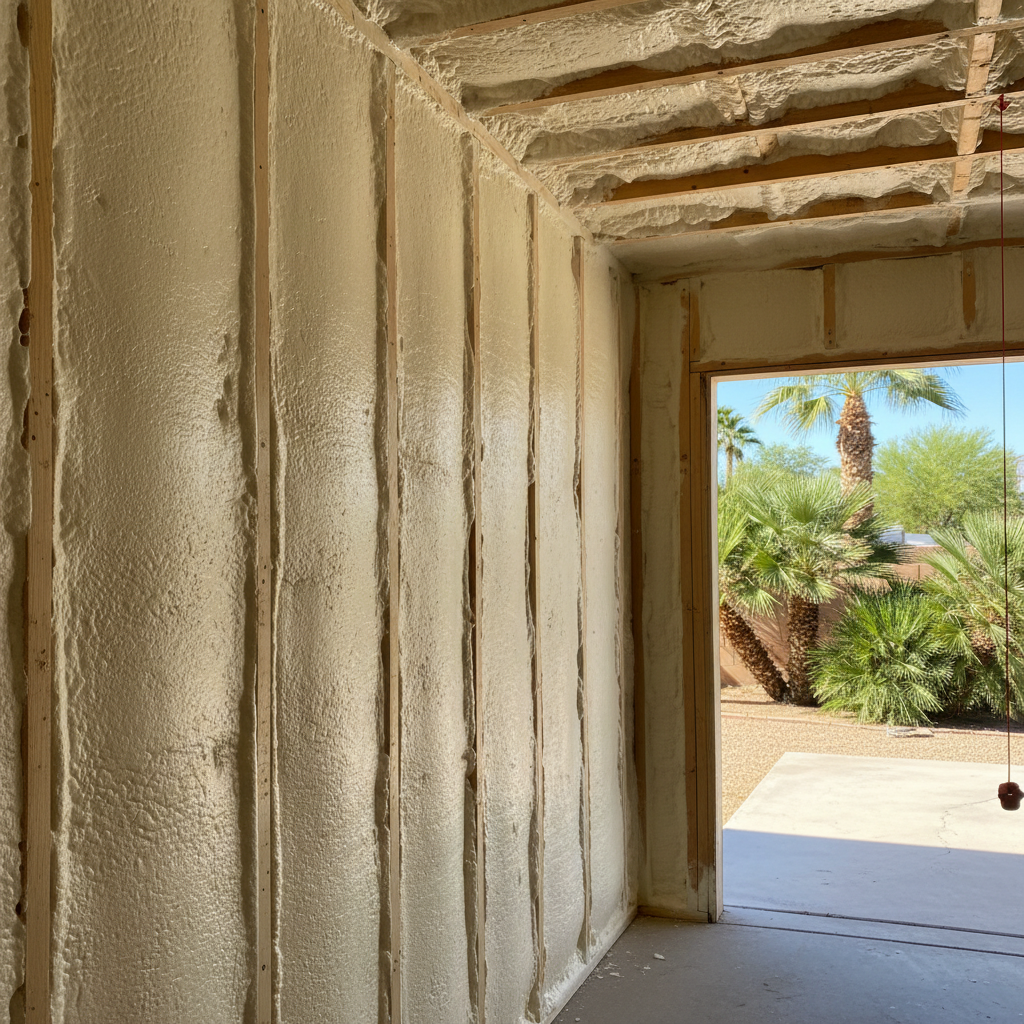
Most homeowners in Mesa, Arizona do not think much about their garage until June rolls around and walking into it feels like stepping in front of an open oven. If you have a workshop out there, store your children sports gear, or share a common wall with your kitchen or master bedroom, that uninsulated metal door and baking drywall are making your whole house work harder. Spray Foam Pros of Mesa gets asked many questions by homeowners trying to make their garages tolerable without spending too much money. Spray Foam Pros of Mesa will review what actually works in our desert climate.
Will insulating my garage actually drop the temperature inside?
Yes, but homeowners must be realistic about what comfortable means when it is 115 degrees outside in Mesa. An insulated garage will not stay naturally 72 degrees in the middle of a July afternoon unless you are running a dedicated air conditioning unit. What Garage Insulation will do is stop that brutal radiant heat from baking the space. When you insulate the walls, seal up the gaps, and tackle the garage door, you typically drop the peak summer indoor temperature by 10 to 20 degrees. More importantly, Garage Insulation keeps that trapped heat from bleeding through your shared interior walls into your actual living space.
What is the best way to handle an uninsulated garage door?
Your garage door is basically a massive sheet of thin metal acting as a solar collector. If you want to fix your garage heat problem, Garage Insulation for the door should start right there. You can go the do-it-yourself route with a polystyrene retrofit kit, or look into having a manufacturer insulated door installed. Just keep in mind that adding heavy wood or thick panels changes the weight balance of the door. If your torsion springs are not adjusted to handle the extra pounds, your opener motor is going to burn out early. Always check the spring tension if you are adding heavy panels.
Should I use spray foam or fiberglass batts for the walls?
It depends on whether your garage walls are already finished with drywall. If the studs are exposed, closed-cell spray foam is very effective for a Mesa garage. Closed-Cell Spray Foam gives you a high R-value per inch, completely seals out air leaks, and does not sag or absorb moisture when the monsoon humidity kicks up. Fiberglass batts are cheaper upfront, but they do not stop air movement. In our climate, air sealing is half the battle. If your garage is already drywalled, dense-packed cellulose or injection foam can sometimes be blown into the cavities without tearing down all your sheetrock.
Do I need to insulate the ceiling if there is an attic above the garage?
If your garage has a standard flat or pitched roof with an attic space above it, treat that ceiling just like the rest of your house. Spray Foam Pros of Mesa sees plenty of Mesa homes where the garage ceiling has bare drywall or minimal insulation, letting the superheated air from the roof deck radiate straight down. Getting that attic space up to standard blown-in or spray foam specs makes a massive difference in how quickly the garage cools down after sundown.
Will insulating my garage lower my electric bill?
Indirectly, yes. If your garage shares a wall with your air-conditioned home, an uninsulated garage acts like a heat sponge, constantly transferring hot air into your drywall. Your HVAC system has to run longer to keep up. By putting a thermal barrier between the garage and the outside elements, you take a heavy load off your central air conditioning unit. Homeowners notice the change most on their summer utility statements.
Can I turn my garage into a home gym or workshop without adding a mini-split AC?
Not comfortably for about four months out of the year. Insulation manages the heat transfer and keeps the space from hitting 120 degrees, but insulation cannot create cooling on its own. If you plan to spend hours out there woodworking, working out, or doing hobbies during a Mesa summer, you will need Spray Foam Insulation to hold the conditioned air, paired with a small ductless mini-split or a portable air conditioner to pull the remaining heat out.